Welcome!... Innerease

About Us
Innerease is a mindful emotional wellness hub that blends holistic healing, expressive therapies, and practical techniques.
Innerease is a mindful emotional wellness hub that blends holistic healing, expressive therapies, and practical techniques.
Welcome!... Innerease
24
Jul
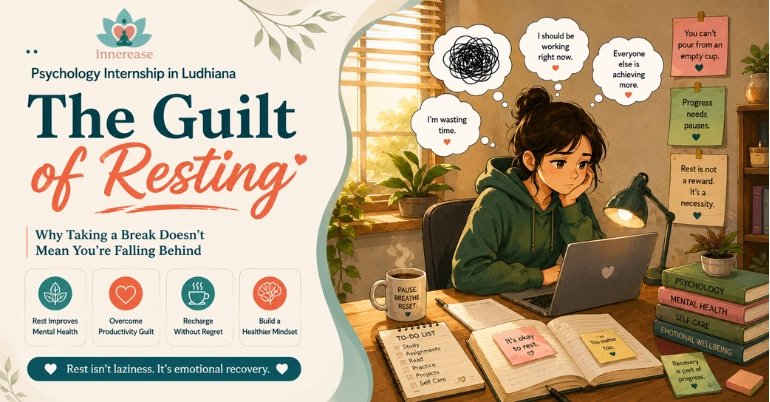
Have you ever finally sat down after a long day, only to feel guilty for not doing something "productive"? Instead of enjoying your break, your mind starts listing unfinished tasks, upcoming deadlines, or things you "should" be doing. If this sounds familiar, you're not alone.
In today's fast-paced world, many people struggle with the guilt of resting. We often associate productivity with success and believe that every moment should be spent achieving something. As a result, taking a break can feel uncomfortable—even when we're mentally and physically exhausted.
At Innerease, we believe that understanding emotional wellbeing begins with recognizing the importance of rest. Whether you're exploring mental health as a career or searching for a psychology internship in Ludhiana, learning about healthy work-life balance is just as important as learning professional skills.
The feeling of guilt often comes from the messages we've heard throughout our lives. Many of us grew up believing that staying busy is a sign of responsibility and success. Phrases like "Don't waste your time," "Work harder," or "Successful people never stop" become deeply rooted in our thinking.
As adults, these beliefs follow us. Even when our body needs a break, our mind tells us that resting is being lazy. Over time, we begin measuring our worth by how much we accomplish instead of how well we take care of ourselves.
Modern society celebrates hustle culture. Social media is filled with people sharing their achievements, career milestones, workout routines, and side projects. It creates the illusion that everyone else is constantly working and succeeding.
This comparison makes us feel like we're falling behind whenever we slow down. Instead of enjoying a quiet evening or taking a day off, we worry that we're not doing enough.
But what we see online is only a small part of people's lives. We rarely see their struggles, burnout, or the breaks they take to recover.
One of the biggest misconceptions is that resting means you're lazy.
Laziness is avoiding responsibilities without reason. Rest, on the other hand, is a conscious decision to recover so you can function better.
Think about professional athletes. They don't train every hour of the day. Recovery is an important part of improving performance. Without proper rest, the body becomes weaker instead of stronger.
The same applies to your mind. Constant work without breaks eventually leads to stress, mental fatigue, and emotional exhaustion.
Ignoring your need for rest doesn't make you more productive. In fact, it often has the opposite effect.
Without enough recovery time, you may experience:
Many people believe they simply need to work harder when, in reality, they need to slow down and recharge. This understanding is also valuable for students pursuing a psychology internship in Ludhiana, as they learn the importance of self-care while supporting others.
Rest isn't just about sleeping more. Your mind and body need different kinds of recovery.
Getting enough sleep, taking short breaks during the day, or simply relaxing your body.
Giving your brain a break from constant thinking, planning, and worrying.
Allowing yourself to express your feelings honestly instead of pretending everything is okay.
Spending less time with people who drain your energy and more time with those who make you feel comfortable and supported.
Taking a break from your phone, social media, emails, and constant notifications.
These forms of rest help restore your energy and improve your overall wellbeing.
It may seem strange, but taking breaks actually helps you get more done.
When your brain is rested, you think more clearly, make better decisions, and solve problems more effectively. Your creativity improves, your patience increases, and everyday tasks become easier to manage.
Working non-stop may feel productive, but it often leads to mistakes, frustration, and burnout.
At Innerease, we encourage a balanced approach to personal and professional growth. Whether you're a student, working professional, or someone enrolled in a psychology internship in Ludhiana, understanding the value of rest can improve both performance and mental wellbeing.
Your body and mind are not machines. Everyone needs time to recover, regardless of how busy they are.
Everyone has a different journey. Social media only shows highlights, not the full story.
Treat your rest like any other important appointment. Whether it's reading a book, taking a walk, or simply sitting quietly, make time for it without feeling guilty.
Ask yourself this question: Would you tell a friend they don't deserve a break after working hard?
Probably not.
Offer yourself the same kindness and understanding.
Success isn't about working every minute of the day. It's about creating a life where you can work, grow, and still have time to recharge.
The guilt of resting is something many people experience, especially in a world that constantly encourages us to stay busy. However, real productivity isn't about doing more every second—it's about knowing when to pause.
Taking a break doesn't make you lazy, unmotivated, or less successful. It helps you return with more energy, better focus, and a healthier mindset.
Remember, you don't have to earn the right to rest. Your wellbeing matters just as much as your achievements. The next time you feel guilty for slowing down, remind yourself that resting isn't holding you back—it's helping you move forward. At Innerease, we're committed to helping you understand the importance of self-care and emotional wellness as part of your journey toward a healthier, more balanced life.

Comments (0)
No comments yet. Be the first to comment!
Leave a Comment