Welcome!... Innerease

About Us
Innerease is a mindful emotional wellness hub that blends holistic healing, expressive therapies, and practical techniques.
Innerease is a mindful emotional wellness hub that blends holistic healing, expressive therapies, and practical techniques.
Welcome!... Innerease
06
Oct
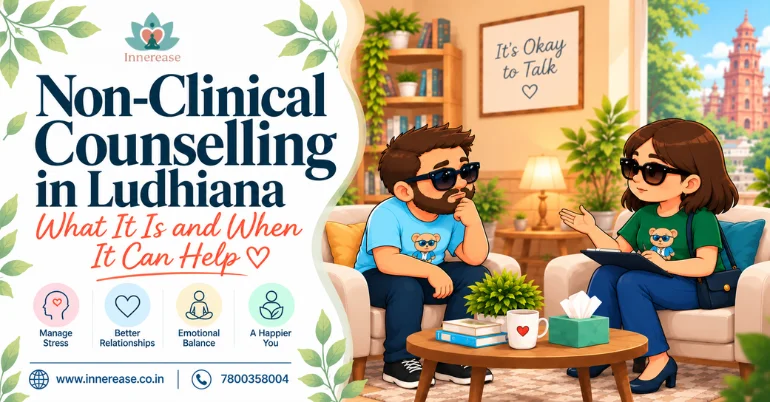
Picture two friends chatting outside a sweet shop. One admits she hasn't slept properly in a month. The other nods and says it happens to everyone. Then they both go home and nothing changes. We do this a lot. We brush off heavy feelings because they seem too small to make a fuss about. But small, ignored feelings have a habit of piling up. If you're curious about talking to someone, Non-Clinical Counselling in Ludhiana is a gentle way in, and this post will walk you through what it really involves.
Non-clinical counselling is a safe place to talk. That's really the heart of it. You bring whatever's on your mind, and a trained counsellor helps you sort through it. No diagnosis, no medicines, no labels.
Some people expect advice. Others expect to be analysed. Neither is quite right. A good counsellor mostly listens, then asks the sort of question you hadn't thought to ask yourself. What would you say to a friend in this situation? That's a classic, and it works more often than you'd expect.
This is where people get confused, so let me keep it short. Psychiatrists and clinical psychologists treat mental health conditions. Non-clinical counsellors support everyday emotional wellbeing, things like stress, relationship trouble, low confidence or plain old overwhelm.Different tools, different purposes. And a decent counsellor will be honest if you need the other kind of help.
Honestly, all sorts of people. Here are a few common situations.
You're the person everyone leans on. Nobody checks on you because you always seem fine. Being needed feels good, until it doesn't.
Marks, rank, parents' hopes, what relatives will say. It's a lot for someone barely out of school. Many students just go quiet.
Same argument, new day. One feels ignored, the other feels blamed. It rarely gets solved at midnight in a raised voice.
A job change, a move, a breakup, a loss. You're not broken, you're just in the middle of something big and nobody gave you a map.
Less formal than you'd think. No clipboard. You sit, you talk, you pause when you need to. The counsellor might repeat back something you said earlier, or gently point out that you've mentioned your father three times in ten minutes. Funny how that happens.
Some days you'll walk out feeling lighter. Other days you'll feel a bit tired, like after a long cry or a hard workout. That's normal too. Change usually doesn't announce itself.
Talking is the core, but it helps to have things to do between sessions. Journaling is simple. Five minutes, no rules, and spelling doesn't matter. Slow breathing can settle your body when your mind is racing. Art works well for people who struggle to find words. Innerease uses these along with conversation so you've got something practical to take home.Don't force any of it. If journaling feels like homework, try something else.
Mostly because of the voice that says other people have it worse. Maybe they do. But feelings aren't a competition, and you don't need a bigger problem to be allowed to talk about yours.
There's also the worry about what others will think. Family, neighbours, colleagues. In a close-knit city that fear is real. Still, counselling is private, and plenty of people quietly go for years before telling anyone. The only opinion that really matters is whether you feel a little better afterwards.
Let me be very clear here. Non-clinical counselling is not a substitute for medical or psychiatric care. If you've been feeling hopeless for weeks, if you're having panic attacks, if your sleep or eating has changed badly, or if you're thinking about harming yourself, please contact a qualified mental health or medical professional. If it's an emergency, call emergency services or reach someone close to you straight away.Asking for the right kind of help is not a failure. It's just sensible.
Don't rush this. Write down what you'd like help with, even roughly. Ask the counsellor about their training and how they work. Find out about fees, timings, cancellations and whether online sessions are available, since life gets busy and Ludhiana traffic isn't kind.
Then pay attention to how you feel. Can you relax a little? Do you feel listened to or hurried along? Trust that feeling. When you're searching for Non-Clinical Counselling in Ludhiana, comfort and honesty matter far more than fancy words on a website.
Counselling does its best work when you support it at home. Charge your phone outside the bedroom. Take a proper lunch break. Say no to one thing this week without explaining yourself for ten minutes. These sound tiny and a bit boring, and that's exactly why they work. You can actually do them.
You don't have to wait until things get bad. If something's been sitting heavy for a while, that's reason enough to talk. And you don't need to know what to say. Most people start with "I don't really know where to begin", and that's a perfectly good beginning.
If you're thinking about Non-Clinical Counselling in Ludhiana, go at your own pace and ask as many questions as you need. Innerease offers a calm, non-clinical space for emotional wellness and personal growth. And if you need clinical care, please speak with a qualified professional.

Comments (0)
No comments yet. Be the first to comment!
Leave a Comment