Welcome!... Innerease

About Us
Innerease is a mindful emotional wellness hub that blends holistic healing, expressive therapies, and practical techniques.
Innerease is a mindful emotional wellness hub that blends holistic healing, expressive therapies, and practical techniques.
Welcome!... Innerease
13
Jun
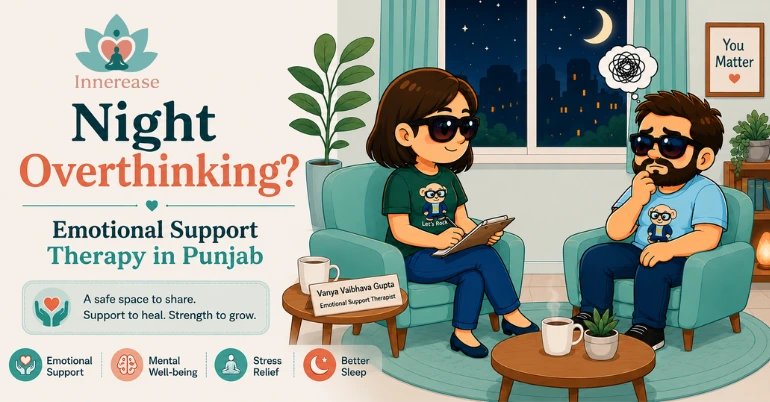
Have you ever noticed how your mind seems quiet during the day but becomes filled with endless thoughts the moment you lie down to sleep? Many people experience this. A simple concern can suddenly turn into a long chain of worries, doubts, and "what if" questions. If this sounds familiar, you're not alone.
At Innerease, we often meet people who struggle with racing thoughts at bedtime. While overthinking can happen at any time, it tends to feel much stronger at night. Understanding why this happens is the first step toward managing it. For those seeking emotional support therapy in Punjab, learning healthy ways to calm the mind can make a significant difference in daily well-being.
During the day, your attention is occupied by work, family responsibilities, conversations, social media, and countless other activities. These distractions keep your brain busy and leave little room for deep reflection.
At night, however, everything slows down. The distractions disappear, the environment becomes quiet, and your mind finally has space to focus on unresolved thoughts. This is when worries about relationships, finances, career goals, health concerns, or future plans often come rushing in.
The silence that should help us relax can sometimes amplify our inner voice.
Even when your body is tired, your brain may still be active. Throughout the day, you collect information, experience emotions, and face challenges. At night, your mind naturally tries to process these experiences.
This mental processing can be helpful, but it often turns into overthinking when you repeatedly analyze situations without reaching a solution. Instead of finding answers, you end up replaying conversations, regretting past actions, or imagining worst-case scenarios.
Lack of energy affects more than just your body; it also impacts your emotional resilience.
When you're tired, it becomes harder to think rationally and manage emotions effectively. Small concerns that seem manageable during the day can feel overwhelming at night. For example:
A minor mistake at work feels like a major failure.
A delayed text message feels like rejection.
An uncertain future feels like a disaster waiting to happen.
Fatigue reduces your ability to put problems into perspective, making overthinking much more intense.
Anxiety and overthinking are closely connected. People who experience anxiety often find that their thoughts become more active when they are trying to rest. Questions such as:
"Did I make the right decision?"
"What if something goes wrong tomorrow?"
"What if people are judging me?"
"What if I fail?"
These thoughts can create a cycle where anxiety fuels overthinking, and overthinking increases anxiety.
The more attention you give these worries, the more powerful they become.
Many people spend most of their day surrounded by noise; phones, television, conversations, notifications, and work tasks.
When night arrives, that constant stimulation disappears. For some individuals, silence creates an opportunity for reflection. For others, it becomes a space where hidden fears and unresolved emotions emerge.
Thoughts that were pushed aside throughout the day suddenly demand attention. This doesn't mean something is wrong with you. It simply means your mind is seeking time to process emotions that may have been ignored.
Scrolling through social media before bed is a common habit, but it can contribute significantly to overthinking. Late-night scrolling often leads to:
Comparing yourself to others
Feeling left behind
Questioning your achievements
Worrying about your appearance or lifestyle
These comparisons can trigger self-doubt and create unnecessary stress right before sleep.
Instead of helping you relax, social media may leave your mind even more active.
Occasional overthinking is normal, but persistent mental rumination can affect your overall well-being. Common signs include:
Difficulty Falling Asleep — You spend hours replaying events or worrying about the future.
Restless Sleep — Even if you fall asleep, your mind remains active, leading to frequent awakenings.
Morning Exhaustion — You wake up feeling tired because your brain never truly relaxed.
Increased Stress Levels — Constant mental activity can leave you feeling emotionally drained throughout the day.
Trouble Concentrating — Overthinking at night often carries over into the next day, affecting productivity and focus.
The good news is that there are practical ways to calm your mind and create healthier sleep habits.
Create a Night-Time Routine
A consistent bedtime routine signals your brain that it's time to relax. Try activities such as:
Reading a book
Taking a warm shower
Listening to calming music
Practicing gentle stretching
These habits help shift your focus away from stressful thoughts.
Write Down Your Thoughts
Journaling is one of the most effective ways to manage overthinking. Before bed, write down:
Your worries
Tasks for tomorrow
Things you're grateful for
Putting thoughts on paper often reduces the need to keep replaying them mentally.
Limit Screen Time
Avoid phones, tablets, and laptops at least 30 to 60 minutes before sleeping. Reducing screen exposure helps your brain transition into a calmer state and decreases mental stimulation.
Focus on Deep Breathing
Slow, controlled breathing can help regulate your nervous system. Try inhaling for four seconds, holding for four seconds, and exhaling for six seconds. This simple practice can reduce tension and bring your attention back to the present moment.
Challenge Negative Thoughts
Ask yourself:
Is this worry based on facts?
Am I assuming the worst?
Will this matter a year from now?
Often, overthinking is fueled by assumptions rather than reality.
If overthinking is affecting your sleep, relationships, work performance, or emotional health, professional guidance can be valuable.
At Innerease, we understand how exhausting constant mental chatter can be. Through supportive counselling and practical coping strategies, individuals can learn to manage stress, regulate emotions, and develop healthier thought patterns.
Many people seeking emotional support therapy in Punjab discover that addressing the root causes of overthinking helps them regain peace of mind and improve their quality of life.
Overthinking gets worse at night because the mind finally has space to focus on unresolved concerns. Fatigue, anxiety, silence, and emotional stress can all make thoughts feel more intense when the day comes to an end.
The key is not to eliminate every thought but to develop healthier ways of responding to them. Small habits such as journaling, limiting screen time, practicing relaxation techniques, and seeking support can make a meaningful difference.
If persistent overthinking is interfering with your daily life, exploring emotional support therapy in Punjab can provide the tools and guidance needed to create a calmer, healthier relationship with your thoughts. Remember, a peaceful mind is not about having no thoughts; it is about learning not to let those thoughts control you.

Comments (0)
No comments yet. Be the first to comment!
Leave a Comment