Welcome!... Innerease

About Us
Innerease is a mindful emotional wellness hub that blends holistic healing, expressive therapies, and practical techniques.
Innerease is a mindful emotional wellness hub that blends holistic healing, expressive therapies, and practical techniques.
Welcome!... Innerease
29
Sep
Have you ever had a lot on your mind but could not really explain what was bothering you?
It happens more often than people realise. You might feel irritated, tired, worried, or simply not like yourself. When someone asks what is wrong, saying "I don't know" can sometimes be the only answer that comes to mind.
Talking is one way of working through emotions, but it is not the only one. Some people find it easier to start with something creative. A blank page, a few colours, some paint, or even simple shapes can provide a different way to express what is going on inside.
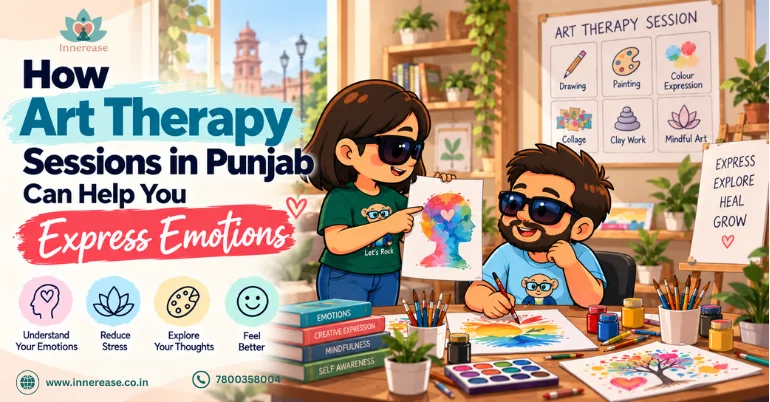
This is where Art Therapy Sessions in Punjab can be helpful. They bring creative activities into a therapeutic setting and give people an opportunity to explore emotions in a way that does not always depend on finding the right words.
The first thing worth clearing up is that art therapy has very little to do with being a good artist.
You could be someone who has not picked up a paintbrush since school. That is completely fine.
You are not attending an art class where someone will look at your work and give you a grade. There is no perfect drawing to make and no particular artistic style you need to follow.
Maybe you draw a few lines. Maybe you fill a page with colours. Maybe you make something that looks like nothing at all.
That is okay.
The creative activity is simply a way to explore what you are thinking and feeling. Sometimes taking away the pressure to explain everything verbally can make it easier to open up.
Feelings can be surprisingly difficult to describe.
Imagine that you have had a stressful week. You know you are not feeling great, but you cannot point to one particular thing. Work may be bothering you. A conversation with someone may still be on your mind. You may also be tired and not getting enough time for yourself.
If someone asks you to explain all of that at once, it can feel overwhelming.
A creative activity can offer another starting point.
You might be asked to choose colours that represent your mood or create something based on a particular experience. While doing that, a thought or memory may come up naturally.
The artwork itself does not provide a diagnosis or a hidden answer. What matters is what you notice and how you personally connect with what you have created.
There is no standard drawing that everyone has to make during an art therapy session.
A session may begin with an ordinary conversation. You might talk about how you have been feeling recently or what brought you to therapy.
The professional guiding the session may then suggest a creative activity.
For one person, that might mean drawing. For another, it could involve colours, painting, clay, collage, or another form of creative expression.
You are given space to work at your own pace. Once you finish, you can talk about the experience with the therapist.
Sometimes the conversation is more interesting than the artwork itself.
You might realise that you kept returning to a particular idea while drawing. You might remember something from your past. Or you might simply notice that you felt calmer while working with colours.
There is no need to force a meaning onto what you create.
For some people, sitting face to face and talking about personal matters can feel uncomfortable at first.
Having something to do with your hands can make the situation feel less formal.
You might be colouring while talking. You might be working on a drawing while discussing something that happened during the week. This can make the conversation feel more natural for some people.
It can also give you a little time to think before answering a difficult question.
That does not mean art therapy is easier for everyone. People respond differently to different forms of therapy. The important thing is finding an approach that feels appropriate for your individual needs.
Modern life can leave very little room to simply stop and check in with yourself.
There are messages to answer, work to finish, family responsibilities, studies, and countless small things competing for attention. Sometimes you get through the entire day without asking yourself how you are actually doing.
Creative activities can provide a chance to slow down for a while.
When you are focused on drawing or painting, your attention is temporarily away from some of those everyday distractions. For some people, this creates an opportunity to think about things they have been putting aside.
Art therapy is not a replacement for professional medical care when medical care is required. It can instead be one part of a broader approach to emotional and psychological support.
Sometimes we avoid certain thoughts because we do not feel ready to deal with them.
A difficult memory may come to mind and then disappear again. A relationship might be causing frustration that you have not talked about. You may keep telling yourself that something does not matter when it actually does.
Creative work can sometimes bring these things closer to the surface.
This does not mean every drawing will reveal some deep hidden message. It simply gives you another activity through which you can notice what is happening in your mind.
Having a therapist there can make that process more structured and supportive.
There is no single type of person who uses art therapy.
Someone may be naturally creative and enjoy the process. Another person may have no interest in art at all but still want to try a different way of expressing themselves.
It may be worth discussing with a qualified professional if you:
Find it difficult to explain your emotions
Prefer activities over sitting and talking for the entire session
Want to explore your thoughts in a creative way
Are dealing with everyday stress
Enjoy drawing, painting, writing, or other creative activities
Want to understand your emotional responses better
A therapist can discuss your situation with you and explain whether this approach makes sense for your needs.
If you are looking for Art Therapy Sessions in Punjab, do not focus only on the activity itself. The person providing the support is equally important.
Take some time to understand their qualifications and experience. You can ask how their sessions work, what types of activities they use, and whether they offer online or in-person support.
It is also worth paying attention to how comfortable you feel when speaking with them. Therapy can involve personal subjects, so having an environment where you feel respected and heard matters.
Innerease is one option to explore if you are looking for professional support and want to learn more about different approaches to emotional well-being.
One of the nice things about creative expression is that there is very little pressure to get it right.
You could take a sheet of paper and start with one colour. Add another. Draw a few shapes. Write something down and turn it into a drawing. There is no need to decide beforehand what the finished piece should look like.
Sometimes the most useful part is simply noticing how you feel while doing it.
You may feel relaxed. You may become more thoughtful. You may remember something. You may even become frustrated with the activity.
All of those reactions can give you something to talk about.
In a professional setting, the therapist can help you explore those reactions without making assumptions about what your artwork means.
It is easy to look at art therapy and think that the painting or drawing is the main point.
It is not.
The person creating it is the important part.
A simple drawing can lead to a meaningful conversation. A page filled with colours can help someone describe a feeling they were struggling to name. Even choosing not to draw much can tell you something about how you are feeling at that particular moment.
The value comes from the reflection and conversation around the experience.
Expressing emotions does not always happen through a long conversation. Sometimes you need a different starting point.
Art therapy sessions in Punjab can provide that starting point by bringing creative activities into a professional therapeutic environment. You do not need artistic talent, and you do not have to create something impressive.
What matters is having the opportunity to slow down, notice what you are feeling, and explore those feelings at your own pace.
If you are considering art therapy, speak with a qualified professional about what you are experiencing and ask whether this approach could be suitable for you. The right form of support can make it easier to understand your emotions and find healthier ways to express them.

Comments (0)
No comments yet. Be the first to comment!
Leave a Comment