Welcome!... Innerease

About Us
Innerease is a mindful emotional wellness hub that blends holistic healing, expressive therapies, and practical techniques.
Innerease is a mindful emotional wellness hub that blends holistic healing, expressive therapies, and practical techniques.
Welcome!... Innerease
03
Aug
Sometimes it feels like you're just going through the motions, right? You put on the right face, answer the texts, show up for work or class, but none of it really connects with how you're feeling inside. It's like you're detached from your own emotions. This is something a lot of young adults seem to be dealing with lately. It's not always a sign of being depressed or not emotionally strong. More often, it's the mind's way of trying to cope when things get too stressful for too long, or if there are emotional experiences that haven't been fully processed.
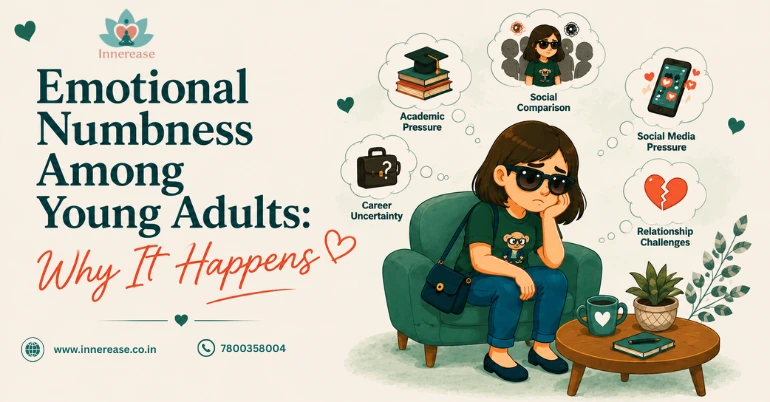
Emotional numbness among young adults is a growing concern in today's fast-paced world. From academic pressure and career uncertainty to social media comparisons and relationship challenges, many young people are silently struggling to feel emotionally connected. Understanding why this happens is the first step toward healing.
Emotional numbness is a state where a person finds it difficult to experience or express emotions. Instead of feeling happy, sad, excited, or even angry, they may feel emotionally "flat" or disconnected. It can affect relationships, motivation, decision-making, and overall quality of life.
Unlike occasional emotional exhaustion after a stressful day, emotional numbness often lasts for weeks or even months. It may leave people wondering why they no longer enjoy the things they once loved.
Young adulthood is filled with major life transitions. People are expected to make important decisions about education, careers, finances, and relationships while also discovering who they are. These pressures can become overwhelming.
Some common reasons include:
1. Constant Stress - Several young people might be studying, working, interning, managing finances, handling family and career pressures. When this is ongoing, the brain can enter the mode of survival making it less emotional as it tries to regulate itself.
2. Social Media Pressure - Scrolling through perfectly edited lives can create unrealistic expectations. Comparing oneself to others often leads to feelings of inadequacy, loneliness, and emotional exhaustion.
3. Fear of Failure - This generation is feeling increased pressure to be successful immediately. Because no one wants to let the family, friends, or even themselves down, emotions are instead internalized.
4. Emotional Burnout - This ultimately leaves you emotionally exhausted and without many feelings as you help everybody else, and leave yourself out completely.
5. Unresolved Emotional Experiences - This can be explained by the fact that past hurts such as disappointment, loss, rejections or a traumatic memory that was not properly dealt with at time eventually may develop into an emotionally void person who learns to detach themselves from emotionally involving circumstances for protection.
Recognizing the signs early is important because emotional numbness among young adults often develops gradually rather than all at once. You might be experiencing it if you:
Feel emotionally disconnected from family and friends.
Lose interest in hobbies you once enjoyed.
Struggle to feel happiness or excitement.
Find it difficult to cry even during emotional situations.
Feel empty or emotionally "blank."
Avoid conversations about feelings.
Experience low motivation despite having goals.
Feel like you're living on autopilot.
These symptoms don't necessarily mean something is seriously wrong, but they do indicate that your emotional well-being deserves attention.
Ignoring emotional numbness can gradually impact different areas of life.
Relationships - People may withdraw from loved ones because they find it difficult to express affection or empathy. This emotional distance can create misunderstandings and loneliness.
Work and Studies - Lack of emotional engagement often reduces productivity and creativity. Tasks begin to feel meaningless, even if they were once enjoyable.
Physical Health - Long-term emotional stress may contribute to fatigue, headaches, poor sleep, and changes in appetite. The mind and body are closely connected.
Self-Confidence - When emotions feel absent, people may start questioning themselves or believing something is fundamentally wrong with them, even though emotional numbness is often a temporary response to overwhelming circumstances.
Yes. Emotional numbness is not permanent. Recovery usually begins with acknowledging your feelings rather than judging them.
Here are a few helpful strategies:
Just spend some time with these feelings each day without judging or managing them; writing them can highlight triggers.
Reduce your time on technology and your mobile devices It helps clear the mind providing some stress relief for emotions.
Emotion and well being are very important – make sure you get adequate sleep. Eating properly also. Exercising will do wonders for your mind and soul.
Just talking things out with someone trustworthy makes one feel not so alone. Then, writing things down can make the matter seem more comprehensible.
Creative hobbies, music, art, reading, or spending time in nature can gradually reconnect you with positive emotions.
In cases where the feeling has lasted for any sustained amount of time or has the potential to spill into your personal and professional life then a counsellor can help a lot, in guiding you how to cope with the emotion.
Change takes time, so be sure that it can be small but effective steps. Concentrate on changing unhealthy habits into ones that are the optimum for your body. Adopt Realistic Expectations, have compassion. Changes may occur due to the fact that it takes a period to produce brand-new you.
Finally keep in mind that asking for a helping hand is a sign of strength and never of weakness. Take care of your mental health just as much as your physical health.
At Innerease, we know the importance of a place where you feel safe, heard, and unjudged, so that you can begin to connect with yourself and slowly start the process of healing. With the help of professional guidance we can explore where this may be coming from, and also how you can develop alternative coping skills to better connect with yourself.
Emotional numbness among young adults is becoming increasingly common as modern life grows more demanding. While it may feel like you've lost touch with your emotions, emotional numbness is often your mind's way of coping with prolonged stress and emotional overload. The encouraging news is that recovery is possible with self-awareness, healthy lifestyle changes, meaningful connections, and professional support when needed.
If you've felt disconnected from yourself or the rest of the world around you for some time, try not to dismiss these feelings. Investing a little time into this at the moment will have benefits over the years. Innerease provides a listening and a feeling care to guide people through their emotions and a pathway towards a happier and more solid life, because to begin on the journey to repair it is vital to acknowledge feelings, although sometimes there seem not to be any in the moment to explore.

Comments (0)
No comments yet. Be the first to comment!
Leave a Comment